
You have probably heard the term ETF thrown around in financial news, investment apps, and conversations about the stock market. But what exactly is an ETF, and why do so many professional and retail investors swear by them? The answer is simpler than you might think and understanding it could fundamentally change how you approach building wealth.

What Is an ETF?
An ETF, or Exchange-Traded Fund, is a type of investment fund that holds a collection of assets like stocks, bonds, commodities, or a mix and trades on a stock exchange just like an individual stock. When you buy one share of an ETF, you are effectively buying a small piece of every asset inside that fund simultaneously.
Think of it like a basket of fruit. Instead of buying one apple (one stock), you buy a basket that contains apples, oranges, bananas, and grapes (hundreds of stocks). If one fruit goes bad, the rest of the basket is unaffected. That is diversification and it is the foundation of smart investing.
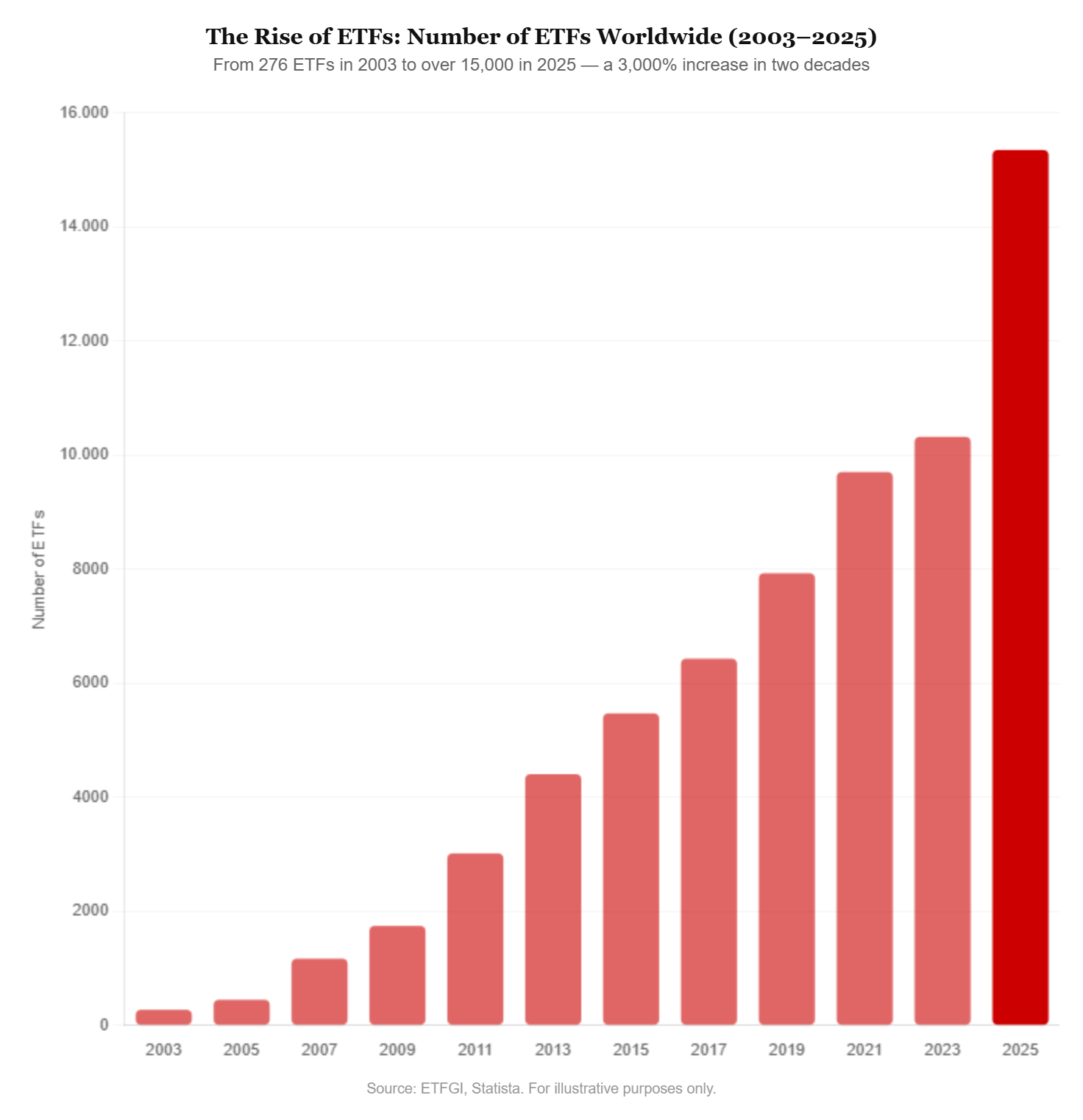
The first ETF was launched in the United States in 1993, tracking the S&P 500. Today there are over 10,000 ETFs globally, covering everything from broad market indices to specific sectors like clean energy, artificial intelligence, or defence.
How Do ETFs Work?
ETFs are created by financial institutions who buy a collection of assets and package them into a fund. They then divide that fund into shares which are listed on a stock exchange. Investors can buy and sell those shares throughout the trading day at market prices, just like individual stocks.
This is one key difference between ETFs and traditional mutual funds. Mutual funds are priced once per day after the market closes. ETFs trade in real time, giving investors more flexibility and transparency.
When you own an ETF share you do not directly own the underlying assets. Instead you own a share of the fund that owns those assets. But economically the effect is the same: your investment rises and falls with the value of the assets inside the fund.
Types of ETFs Explained
Index ETFs
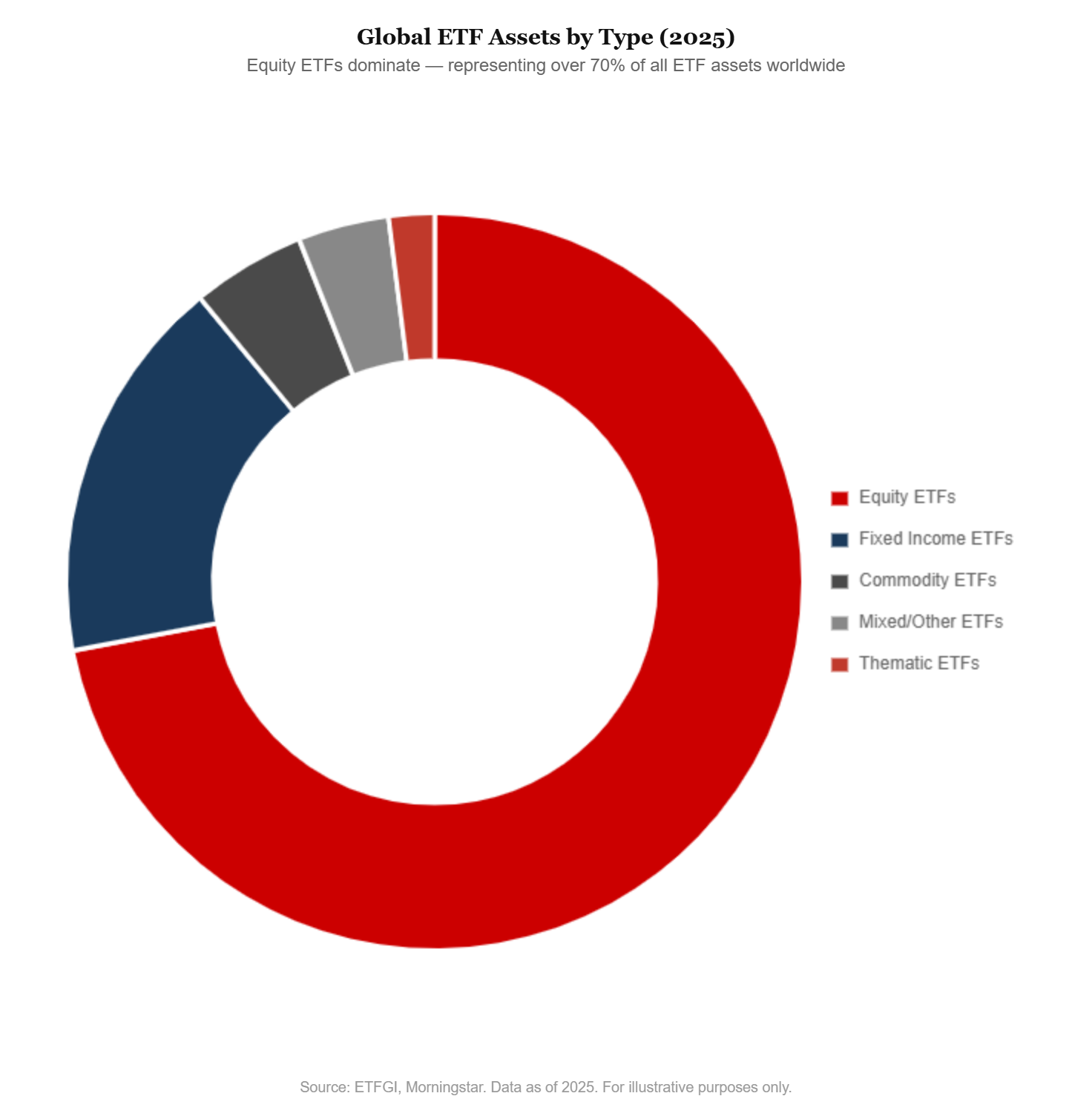
The most common and widely recommended type. These track a market index like the S&P 500, FTSE 100, or MSCI World. They simply replicate the performance of that index with no active management, no stock picking, just pure market exposure. Examples include Vanguard’s VOO (S&P 500) and iShares’ IWDA (MSCI World).
Sector ETFs
These focus on a specific industry or sector like technology, healthcare, energy, financials. They give you targeted exposure without having to pick individual companies. For example, a technology ETF might hold Apple, Microsoft, Nvidia, and hundreds of other tech companies in one fund.
Bond ETFs
Instead of stocks, these hold bonds like government or corporate debt. They provide income through regular interest payments and are generally less volatile than equity ETFs. Bond ETFs are popular with more conservative investors or those approaching retirement. However, bond ETFs and bonds in general are quite interesting as they add an extra layer of complexity compared to index or sector ETFs. This additional feature is maturity. The maturity of a bond refers to the date on which it expires and the principal is repaid to the investor. It is one of the most important characteristics of any bond because it directly determines its price volatility; the longer the maturity, the more sensitive the bond is to changes in interest rates. A 30-year government bond will fluctuate far more in price when rates move than a 2-year bond, making long-duration bonds significantly riskier in rising rate environments.
Commodity ETFs
These track the price of physical commodities like gold, oil, or agricultural products. Gold ETFs in particular are widely used as inflation hedges and as safe havens under recessions. Rather than storing physical gold, investors can gain exposure to gold prices through a simple ETF purchase.
Thematic ETFs
A newer category that focuses on specific investment themes likeartificial intelligence, clean energy, cybersecurity, ageing populations. These carry higher risk than broad index ETFs but appeal to investors with strong views on specific long-term trends.
Why ETFs Matter for Everyday Investors
1. Instant Diversification
A single ETF tracking the MSCI World index gives you exposure to over 1,500 companies across 23 developed countries. That level of diversification would be impossible to replicate by buying individual stocks as it would require enormous capital and thousands of transactions. With one ETF purchase, you achieve it instantly.
2. Low Cost
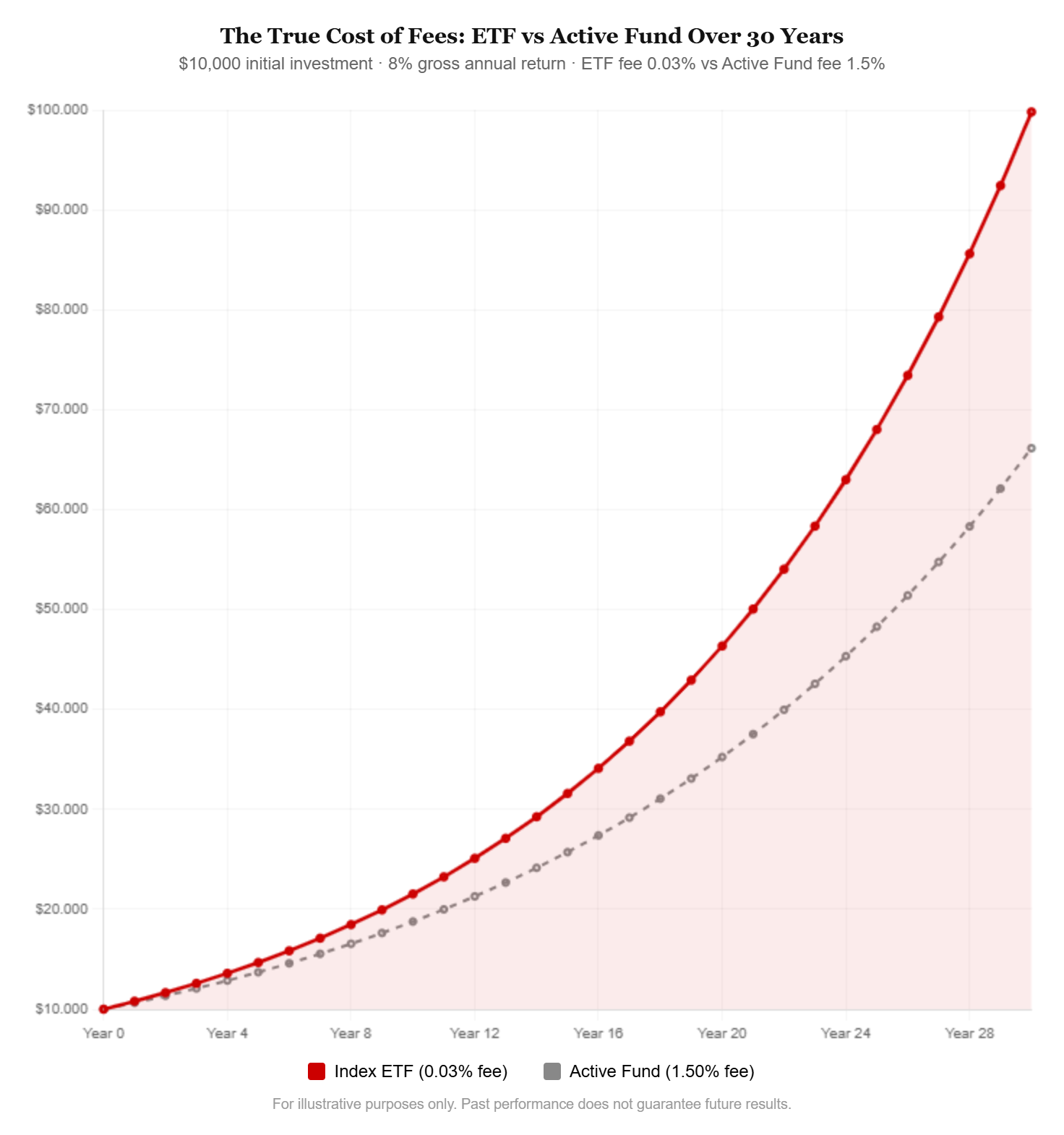
This is perhaps the most compelling advantage. Traditional actively managed funds charge annual fees called expense ratios of 1% to 2% or more. Many index ETFs charge as little as 0.03% to 0.20% per year. Over 30 years, that difference in fees can amount to tens of thousands of dollars in additional returns. Quite often these expense ratios have caused actively managed funds to underperform their benchamrk.
3. Transparency
ETFs disclose their holdings daily. You always know exactly what you own inside the fund. Actively managed funds often disclose holdings only quarterly, leaving investors uncertain about what their money is actually invested in.
4. Tax Efficiency
ETFs are generally more tax-efficient than mutual funds due to their unique structure. They generate fewer taxable events, which means more of your returns stay in your pocket rather than going to the tax authorities. The specific tax treatment varies by jurisdiction so it is important that you consult a tax advisor for advice relevant to your country.
5. Accessibility
With fractional share investing now widely available, you can buy into most ETFs for as little as $1. There is no minimum investment requirement beyond the price of one share and often not even that.
ETFs vs Individual Stocks: Which Is Right for You?
This is one of the most common questions among new investors. The honest answer is that for most people, ETFs should form the core of their portfolio with individual stocks as an optional addition for those who enjoy researching companies.
Here is why. Selecting individual stocks that consistently outperform the market is extraordinarily difficult. Study after study shows that the majority of professional fund managers fail to beat their benchmark index over 10-year periods. If professionals with teams of analysts and decades of experience struggle, the odds for individual retail investors are even longer.
ETFs remove that challenge entirely. By owning the market rather than trying to beat it, you capture the overall growth of the economy over time. Warren Buffett himself has repeatedly recommended low-cost index ETFs for the majority of investors not individual stock picking.
That said, owning individual stocks can be rewarding, educational, and occasionally very profitable. A sensible approach for many investors is a core ETF portfolio supplemented by a smaller allocation to individual stocks they have researched and believe in.
How to Buy Your First ETF
- Open a brokerage account: choose a regulated platform in your jurisdiction
- Search for the ETF by its ticker symbol (e.g. VOO for Vanguard S&P 500 ETF)
- Check the expense ratio: lower is better, aim for below 0.2%
- Check the assets under management: larger funds are generally more stable and liquid
- Place your order: you can buy at market price or set a limit order
- Hold long term: ETFs work best as long-term investments, not short-term trades
Key Takeaways
- An ETF is a fund that holds a collection of assets and trades on a stock exchange like a stock
- They provide instant diversification, low costs, and transparency
- Index ETFs tracking the S&P 500 or MSCI World are the most recommended starting point for beginners
- ETFs are more cost-efficient than actively managed funds over the long term
- Warren Buffett recommends low-cost index funds for most investors
- You can start investing in ETFs with as little as $1 through fractional share platforms
An ETF or Exchange-Traded Fund is a basket of investments such as stocks, bonds, or commodities that trades on a stock exchange like a single share. It allows you to invest in many assets at once without having to buy each one individually.
Both hold a collection of assets but ETFs trade throughout the day on stock exchanges like individual stocks, while mutual funds are only priced and traded once per day after market close. ETFs also typically have lower fees than actively managed mutual funds.
ETFs are generally considered one of the most beginner-friendly investment options because they offer built-in diversification, low costs, and transparency. However all investments carry risk and ETF values can fall as well as rise.
Some of the most widely held beginner ETFs include those tracking the S&P 500 such as VOO and SPY, total market funds, and broad bond ETFs. These offer wide diversification at very low annual costs.
Conclusion
ETFs are not a complicated financial product reserved for sophisticated investors. They are one of the simplest, most cost-effective, and most powerful tools available to anyone who wants to build wealth over time. Whether you are investing $100 or $100,000, understanding and using ETFs effectively is one of the best financial decisions you can make.