
When financial markets collapse, when currencies lose their value, and when governments print money at unprecedented rates, investors throughout history have turned to one asset above all others: gold. But does gold actually deliver during economic crises? The historical record offers a clear, data-rich answer that every investor should understand before deciding whether gold belongs in their portfolio.
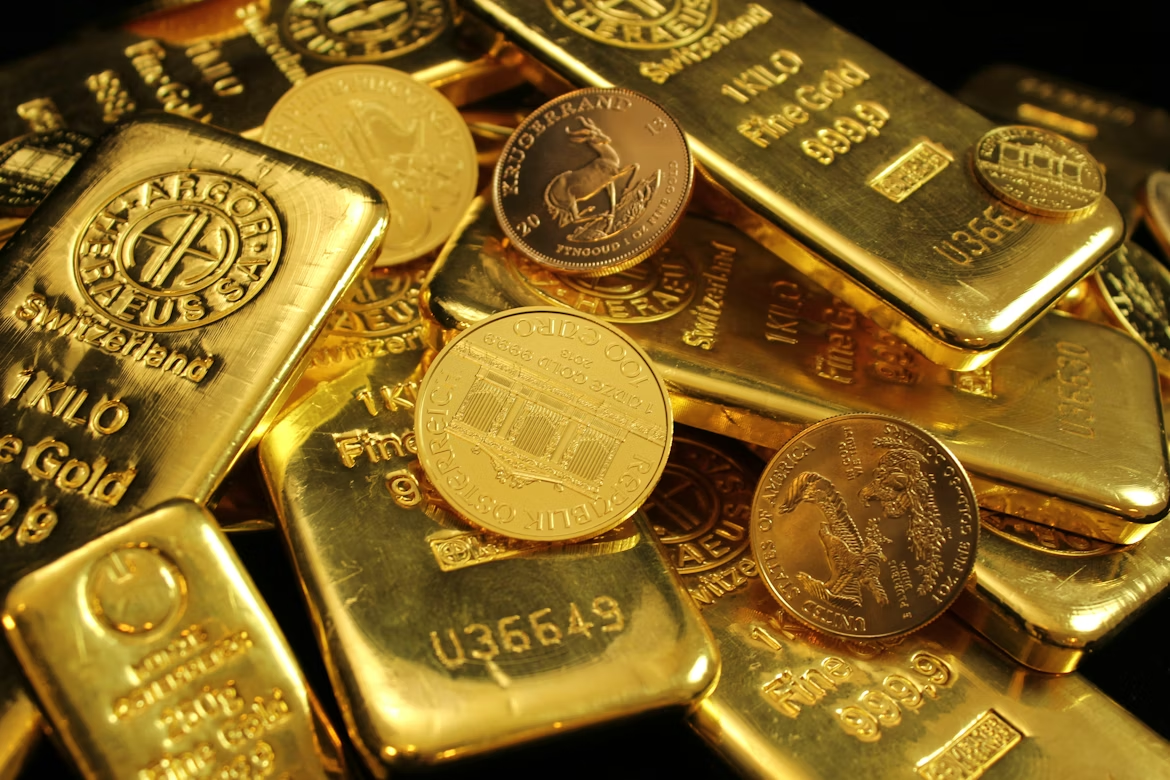
Why Gold Is Considered a Safe Haven Asset
Gold’s status as a safe haven asset is not a modern invention. For thousands of years, gold has served as a store of value precisely because it cannot be printed, diluted, or defaulted on. Unlike a government bond or a bank deposit, gold carries no counterparty risk as its value does not depend on the promises of any institution or government.
Three forces consistently drive gold higher during economic crises. First, central banks cut interest rates, which reduces the opportunity cost of holding gold; a non-yielding asset. Second, governments inject stimulus and expand the money supply, raising inflation concerns that make real assets more attractive. Third, fear itself drives demand as investors seeking safety pour money into gold when confidence in financial institutions wavers.
Since 1970, gold has averaged 20.2% gains during official recession periods though as we will see, the timing, magnitude, and type of crisis all play a significant role in how gold actually performs.
The 2000–2002 Dot-Com Bust
The collapse of the technology bubble provides an instructive early case study. During the dot-com bust, the S&P 500 fell 49% while gold gained 15%. While the gain was modest compared to later crises, gold’s direction was clear as stocks collapsed under the weight of overvaluation and investor panic, gold moved the other way, beginning a multi-year bull run that would continue for a decade.
The 2008 Global Financial Crisis
The 2008 financial crisis is the most important case study for understanding gold and the most misunderstood. In March 2008, gold touched $1,011. By October, it had dropped to $730 representing a 28% decline during the worst financial crisis since the Great Depression.
This initially confusing performance has a clear explanation. In a severe liquidity crisis, everything gets sold. Banks, hedge funds, and institutional investors needed cash immediately to meet margin calls after Lehman Brothers collapsed. They liquidated whatever they could including gold. This created a temporary but sharp disconnect between gold’s long-term value and its short-term price.
What happened next validated gold’s safe haven status conclusively. From that October 2008 low, gold surged 78% within two years ultimately gaining 163% from the crisis bottom by August 2011 when it reached $1,917.90 per ounce.
The lesson from 2008 is not that gold failed as a safe haven but it is that in extreme liquidity crises, gold experiences a temporary dip before recovering powerfully. Investors who understood this dynamic and held through the volatility were rewarded with extraordinary returns.
The 2020 COVID-19 Recession
The pandemic-induced recession of 2020 demonstrated gold’s evolved crisis response. Gold advanced from $1,485 per ounce on March 1, 2020, to $2,069 per ounce by August 2020, representing a 39.3% gain during the recession period.
Unlike 2008, the recovery happened in months rather than years. The Federal Reserve’s unprecedented response by cutting rates by 150 basis points in a single month and expanding its balance sheet from $4.2 trillion to $7.4 trillion by June 2020 created near-ideal conditions for gold. More money in the system, near-zero interest rates, and massive uncertainty drove investors to gold at record pace.
The 2022–2024 Inflation Era and Gold’s New All-Time Highs
The post-COVID inflation shock added another chapter to gold’s record. As inflation hit multi-decade highs globally and geopolitical tensions escalated because of Russia’s invasion of Ukraine, US-China tensions, Middle East instability gold climbed steadily. In January 2026, gold reached a new all-time high of $5,419.80 per ounce though it has pullen back to around $4,600 as of late April 2026, driven by concerns about tariffs and a potential trade war.
This run demonstrated that gold’s appeal extends beyond recessions; geopolitical instability, currency concerns, and de-dollarization trends by central banks worldwide are also powerful drivers of gold demand.
Gold vs Stocks During Major Crises. The Key Comparison
The data across major crises tells a consistent story:
| Crisis | S&P 500 | Gold |
|---|---|---|
| Dot-com bust (2000–2002) | -49% | +15% |
| Global Financial Crisis (2008) | -55% peak to trough | Flat in 2008, +163% by 2011 |
| COVID-19 (2020) | -34% peak to trough | +39% March–August 2020 |
The pattern is clear; gold and stocks tend to move in opposite directions during major downturns, making gold a genuine diversifier rather than simply another risk asset.
The One Exception — 1990–1991 Recession
In five of the six major recessions studied, gold prices increased as the strength of the general economy decreased. The one outlier was the 1990–1991 recession, when gold prices decreased modestly. This exception is worth noting as gold is not guaranteed to rise in every economic downturn. The type, severity, and policy response all influence gold’s behavior.
How Much Gold Should You Hold?
Most financial advisors suggest allocating between 5% and 15% of a portfolio to precious metals, calibrated to risk tolerance. A common approach is a core allocation of 5–10% in gold as a long-term hedge against inflation, currency debasement, and geopolitical instability not as a speculative trade.
Gold can be held in several forms; physical gold (coins and bars), gold ETFs like SPDR Gold Shares (GLD) or iShares Gold Trust (IAU), gold mining stocks, or gold futures. For most retail investors, gold ETFs offer the most practical and cost-effective exposure.
Key Takeaways
- Gold has averaged 20.2% gains during official recession periods since 1970
- During severe liquidity crises, gold may initially drop alongside stocks before recovering powerfully
- Gold gained 163% from its 2008 crisis low by 2011 rewarding patient investors
- Gold rose 39% during the COVID-19 recession in just five months
- The 1990–1991 recession is the only major downturn where gold underperformed
- Most advisors recommend a 5–15% portfolio allocation to gold as a long-term hedge
- Gold ETFs offer the most practical exposure for retail investors
Gold has been used as a store of value for thousands of years. During economic crises, market crashes, or periods of high inflation, investors tend to move money into gold because it holds its purchasing power when paper currencies and stock markets decline.
Not always, but historically gold has performed well during periods of economic uncertainty. During the 2008 financial crisis and the COVID-19 pandemic gold prices rose significantly as investors sought safety. However short-term price movements can be unpredictable.
Gold is widely seen as a hedge against inflation. When inflation rises and the purchasing power of paper money falls, gold tends to increase in value because it maintains its real worth over time unlike cash sitting in a low-yield account.
The most accessible ways to invest in gold without physically owning it include gold ETFs, gold mining stocks, and gold-backed funds. These can be bought through standard brokerage accounts without the need to store physical gold.
Conclusion
Gold is not a perfect asset as nothing is. But its historical track record during economic crises is compelling. It has preserved wealth, diversified portfolios, and rewarded patient investors through some of the most turbulent periods in modern financial history. Understanding when and why gold performs and the temporary dislocations that can occur in extreme crises is essential knowledge for any investor building a portfolio for uncertain times.